
Song credits
- Year
- 2024
- Duration
- 2:57
- Composer
- Komitas
- Arranger
- Tigran Ter-Stepanyan
Biography
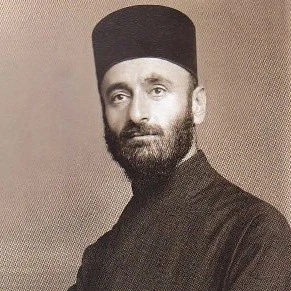
Komitas
Komitas (Soghomon Soghomonyan) was born in Anatolia, Turkey, in the town of Kutina (Kutahya). At the age of 7, he entered the local elementary school. As soon as he finished elementary school at 11 years old, his father sent him to Broosa to continue his education. However, Soghomon's father tragically died 4 months after his arrival and he was forced to return home. He could sing beautifully and in Kutina was nicknamed “a little vagrant singer”. In 1881, Kutina's priest, G. Derdzakyan, went to Echmiatsin to be ordained a bishop. He was asked by the Holy See of Echmiatsin to select an orphan boy with a good singing voice to study at the distinguished Gevorgian Seminary. He chose a 12-year-old Komitas. Greeted by the Catholicos Gevorg IV, Soghomon replied in Turkish, “I don’t speak Armenian, but if you wish, I will sing”. Then, with his fine soprano voice, he sang an Armenian sharakan (sacred chant), deeply impressing the Catholicos. Over the next years, Komitas found "emotional and intellectual stability" in the seminary. It was also here that he learned the Armenian Khaz music notation system he would use for transcription throughout his life and developed a deep passion for music. With his newfound skills, Komitas began to transcribe songs he heard in nearby Armenian villages, earning the title "Notaji Vardapet" ("the note-taking priest"). In 1890 Soghomon was ordained a monk. In 1893 he graduated from the seminary, was awarded the rank of the Priest, and acquired his new name “Komitas” - the name of an outstanding poet of the VII century, the author of sharakans. At the seminary, Komitas was appointed as a music teacher and as choirmaster of Echmiatsin Cathedral. In 1895 he was ordained the spiritual rank of the Archimandrite (a title of honor for service to the church). In October 1895, Komitas left for Tbilisi, Georgia, to study at its musical college. However, upon meeting the composer Makar Yekmalyan he changed his mind and started studying his course on harmony. Komitas then decided to move to Berlin under the sponsorship of the millionaire Aleksandr Mantashyan. In Berlin, Komitas entered the private conservatory of Professor Richard Schmidt and attended lectures on Philosophy, Aesthetics, General History and History of Music at the Imperial University of Berlin. Upon the invitation of the International Music Association, he gave lectures devoted to the Armenian church and its contemporary music in comparison with Turkish, Arabic and Kurdish music. In September 1899, Komitas returned to Echmiatsin. He organized a small orchestra and assembled and rigorously trained a polyphonic choir. He spent a great deal of time traveling throughout the Armenian countryside, transcribing and preserving thousands of Armenian, Kurdish, Persian and Turkish songs. He also toured around the world as a performer and promoter of traditional Armenian music. With his free time, he began a preliminary writing of the musical epic “Sasna tsrer” and continued working on the opera “Anush”, which he started in 1904. Komitas was passionately focused on the themes and content of folk music and love songs, which bred tension with the ultraconservative Etchmiatsin clergy. Gradually, the disapproval of new leaders and the resulting gossip and harassment pushed Komitas into an identity crisis. In desperation, he sent a letter to the Catholicos, begging him to release him and let him live and make music peacefully. This request remained unanswered. In 1910 Komitas left Etchmiatsin for Constantinople. There, he expected to find an environment that would nurture him, protect him, and encourage him, allowing him to fulfill his dream: establishing a National Conservatory with which he could honor and immortalize the music of Armenia. Sadly, all his ideas were only faced with the indifference of the local musical authorities. Unwilling to be defeated, Komitas organized a mixed choir of 300 men called “Gousan”, delivered presentations and lectures, and gave many of his own concerts, performing both as a soloist and conductor. He was endowed with the great power to excite and persuade his listeners - in 1906, after the performance of one of Komitas' concertos, Claude Debussy exclaimed: “Brilliant father Komitas! I bow in front of your musical genius!”. Despite the praise of illustrious composers, however, Komitas could not find supporters who would help him implement his plans in Constantinople. Moreover, he felt distanced from his native people and the Armenian music he was deeply passionate about. However, he continued his hard work. Komitas paid special attention to the composition of church music. In this field his masterpiece is “Patarag”, (first published in 1933) written for a male chorus. He was also one of the pioneers of ethnomusicology. At the Paris Conference of the International Music Society, he gave two presentations: “Armenian Folk Music” and “On Old and New Notation of Armenian Spiritual Music”, which provoked great interest among musicologists. He was requested to give a spontaneous presentation on the topic: “On Time, Place, Accentuation and Rhythm of Armenian Music.” During World War I, the government of Young Turks initiated their monstrous massacre of the Armenian people. In 1915, Komitas was arrested along with 180 prominent Armenian writers, publicists, doctors and lawyers. He was violently exiled to the depths of Anatolia, Turkey, where he witnessed the brutal torture and killing of Armenian people. Although Komitas was returned to Constantinople after the intervention of influential friends and US ambassador Henry Morgenthau, the nightmare he had experienced left a deep, ineradicable impression on his psyche. He was severed from the outside world, broken by his trauma. In 1916 he was put in a psychiatric hospital. He found his final shelter in Paris, in the suburban sanatorium Vil-Jouif, where he spent almost 20 years of his life. He sadly passed away in a Paris psychiatric hospital in 1935. In the spring of 1936 his remains were transported to Armenia and buried in Yerevan in the Pantheon of prominent art figures. Despite the tragic circumstances of his final years and death, Komitas has left a significant and enduring impression on the Armenian - and international - musical world. Through his tireless efforts to transcribe and publish so many folk songs (around 3000), he has preserved the cultural heritage of Western Armenia, that otherwise would have been destroyed and lost forever due to the genocide. The Yerevan State Musical Conservatory is named after him, as well as the world-renowned string quartet, Komitas Quartet. He also appears on the 10000 dram banknote. His legacy will endure for centuries to come. As Vazgen I, Catholicos between 1955 and 1994, put it, "The Armenian people found and recognized its soul, its spiritual nature, in Komitas’ songs. Komitas Vardapet is a beginning having no end. He will live through the Armenian people, and they must live through him, now and forever”.